
Conny Maier: Landscape, Instinct, and the Politics of Imagination
- Cultural Dose

- Feb 2
- 2 min read
The joint representation of Conny Maier by SOCIÉTÉ and Hauser & Wirth signals more than a strategic alignment between two influential galleries. It marks a decisive moment in the trajectory of an artist whose work confronts the psychological and ecological conditions of the present with unapologetic intensity.

Born in Germany and now living and working in Portugal, Maier’s practice is shaped by geographic and climatic displacement. Her paintings and sculptures operate within a space where landscape is never neutral and paradise is always unstable. Vivid colour and graphic clarity pull the viewer in, but what unfolds is rarely comfort. Her scenes are populated by distorted figures, hybrid beings, animals, ritual objects, and offerings, forming worlds that feel instinctual rather than illustrative. These are not imagined utopias, but charged environments where human desire, fear, and ecological imbalance collide.
Maier’s work resists the romanticisation of nature. Instead, she treats landscape as a psychological and political terrain, infused with unease. Geological forms buckle. Bodies merge or mutate. Flowers, animals, and symbolic artefacts recur not as decoration, but as anchors for emotional states and behavioural patterns. Her compositions suggest systems under pressure, where human intervention and natural force are locked in continuous negotiation.

This tension is central to Maier’s relevance today. As climate anxiety reshapes cultural consciousness, her work refuses didacticism in favour of visceral experience. The landscapes may appear lush, even seductive, but they are charged with threat. They reflect a world where equilibrium is temporary and intention does not guarantee control. The narrative quality of her tableaux allows meaning to emerge gradually, encouraging reflection rather than resolution.
Hauser & Wirth’s President Marc Payot situates Maier’s practice within a lineage of artists who have used figuration as a vehicle for psychological and political force, referencing figures such as Maria Lassnig and Erna Rosenstein, alongside a younger generation including Angel Otero and Firelei Báez. This positioning is not incidental. It frames Maier as part of an ongoing conversation about embodiment, identity, and the instability of perception.
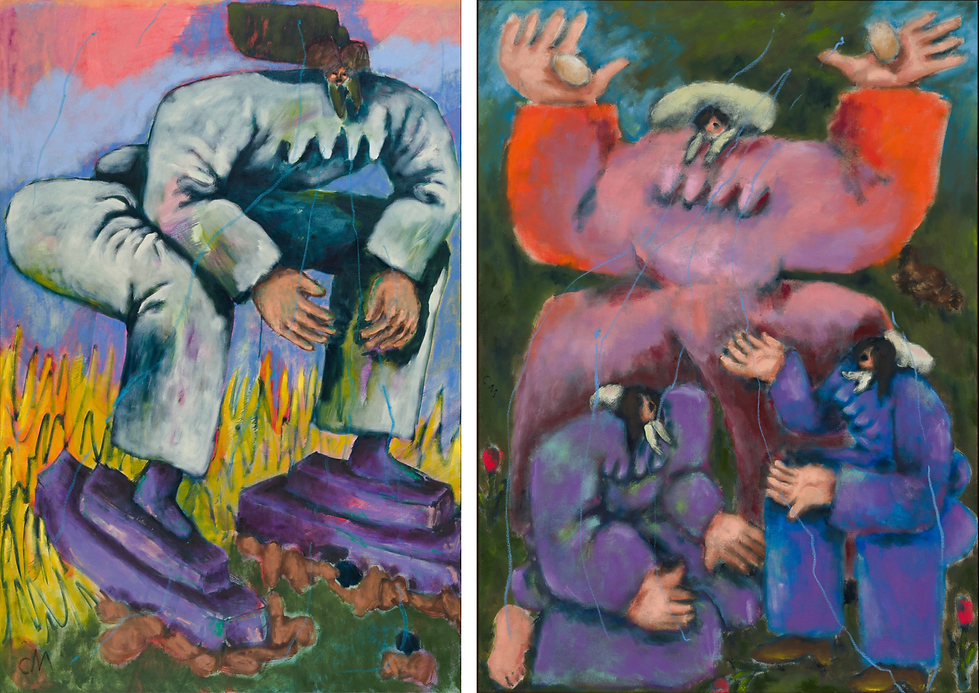
The collaboration also reflects a shared commitment to long-term artistic development rather than short-term visibility. SOCIÉTÉ, which has played a formative role in Maier’s career, now joins forces with a global platform capable of amplifying her work across continents. The announcement of a solo stand at Frieze LA introduces her practice to new audiences while preserving its conceptual density.
What distinguishes Conny Maier’s work is its refusal to simplify. It acknowledges that beauty and violence often coexist, that imagination can be both liberating and unsettling. Her worlds are constructed, but they feel instinctive, shaped by forces that operate beneath language. In this sense, her paintings do not offer commentary from a distance. They place the viewer inside the problem.
This new chapter, shared between SOCIÉTÉ and Hauser & Wirth, affirms Maier’s position as an artist attuned to the pressures of contemporary life. Her work does not illustrate crisis; it inhabits it. And in doing so, it offers a form of reflection that is neither consoling nor detached, but urgent, embodied, and impossible to ignore.


