
Joan Eardley at Catterline: Painting Against the Edge
- Cultural Dose

- May 1
- 2 min read
At The Granary Gallery, Joan Eardley: The Sea at Catterline returns one of Britain’s most formidable painters to the elemental force that transformed her practice. Running from June to October 2026, the exhibition shifts attention from the urban intensity of Glasgow’s street children works that have long anchored Joan Eardley’s reputation to the raw coastal terrain of Catterline, where her work reached its most physically charged expression.
If Glasgow gave Eardley human immediacy, Catterline gave her confrontation.
First arriving in the Aberdeenshire fishing village in 1951, Eardley encountered a landscape that resisted passive observation. The sea was not simply scenery. It was movement, force, instability. It demanded a new visual language. What emerged over the following decade was a body of work that pushed her beyond representation and toward something closer to immersion.
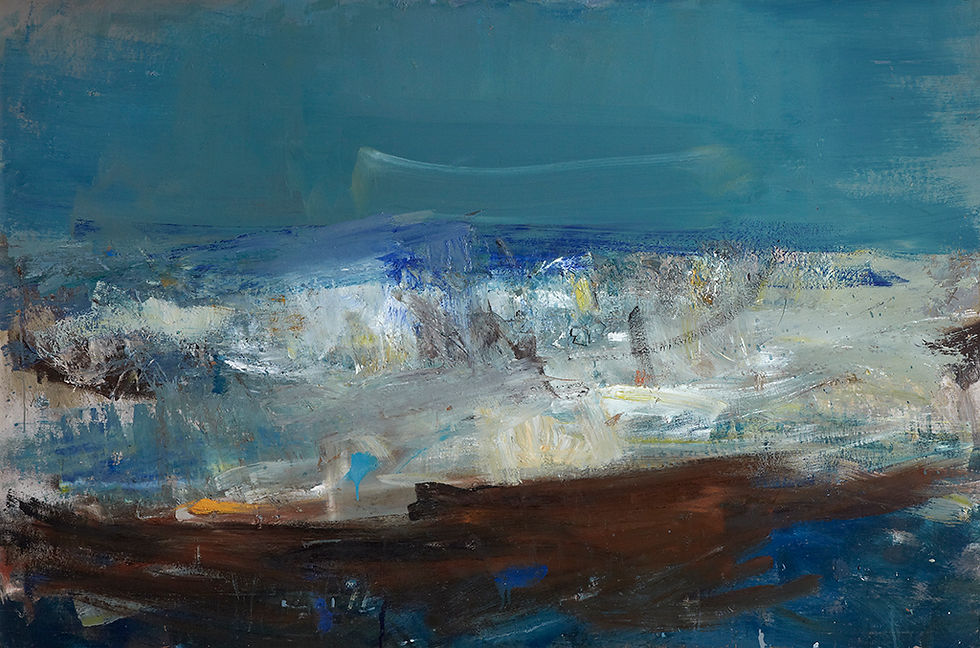
The North Sea became both subject and method.
Painting outdoors, often in punishing conditions, Eardley embraced the unpredictability of the environment itself. Sand, grasses, boat paint, newspaper her materials expanded beyond conventional paint, collapsing distinctions between image and terrain. These were not paintings of landscape in the pastoral sense. They were surfaces marked by weather, resistance, and exposure.
This material experimentation aligned her increasingly with the energies of abstraction, though never at the expense of place. The influence of abstract expressionism is evident in the gestural force of her later works, but Eardley’s paintings remain deeply rooted in observation. Her seascapes do not abandon landscape. They intensify it.
Works such as Summer Sea and The Sea II reveal this shift with startling clarity. Waves become structure, motion becomes texture, and the canvas itself seems to register the violence and rhythm of the coast. Eardley was not attempting to capture appearance alone. She was painting impact.
The exhibition’s focus on the years between the mid-1950s and her death in 1963 is particularly significant. This period marks not simply maturity, but acceleration. Her work becomes freer, more forceful, and more willing to test the limits of painterly control. The sea offered a subject expansive enough to absorb this transformation.
Yet The Sea at Catterline also broadens the narrative through attention to Eardley’s personal and artistic relationships, including figures such as Margot Sandeman and Lil Neilson. These inclusions complicate the mythology of solitary genius, situating Eardley within networks of intimacy, influence, and emotional complexity.
What makes this exhibition particularly resonant is its geographical placement. Berwick-upon-Tweed, itself positioned at a threshold between England and Scotland, becomes an apt site for revisiting an artist whose work frequently occupied edges between urban and rural, figuration and abstraction, tenderness and severity.
Eardley’s death at 42 has often contributed to the sense of her career as something interrupted. But this exhibition resists framing her late work through loss alone. Instead, it emphasises culmination. These paintings are not unfinished trajectories. They are declarations of confidence.
Standing on the cliff edge at Catterline, often in her RAF suit and boots, Eardley painted not from distance, but from within the force of what confronted her.
At The Granary Gallery, that force remains palpable. These are not simply seascapes. They are acts of endurance.