Two Little Pigs - Caitlin McEwan on masculinity, online culture and Two Little Pigs at the Edinburgh Festival Fringe
- Cultural Dose

- 18 hours ago
- 6 min read
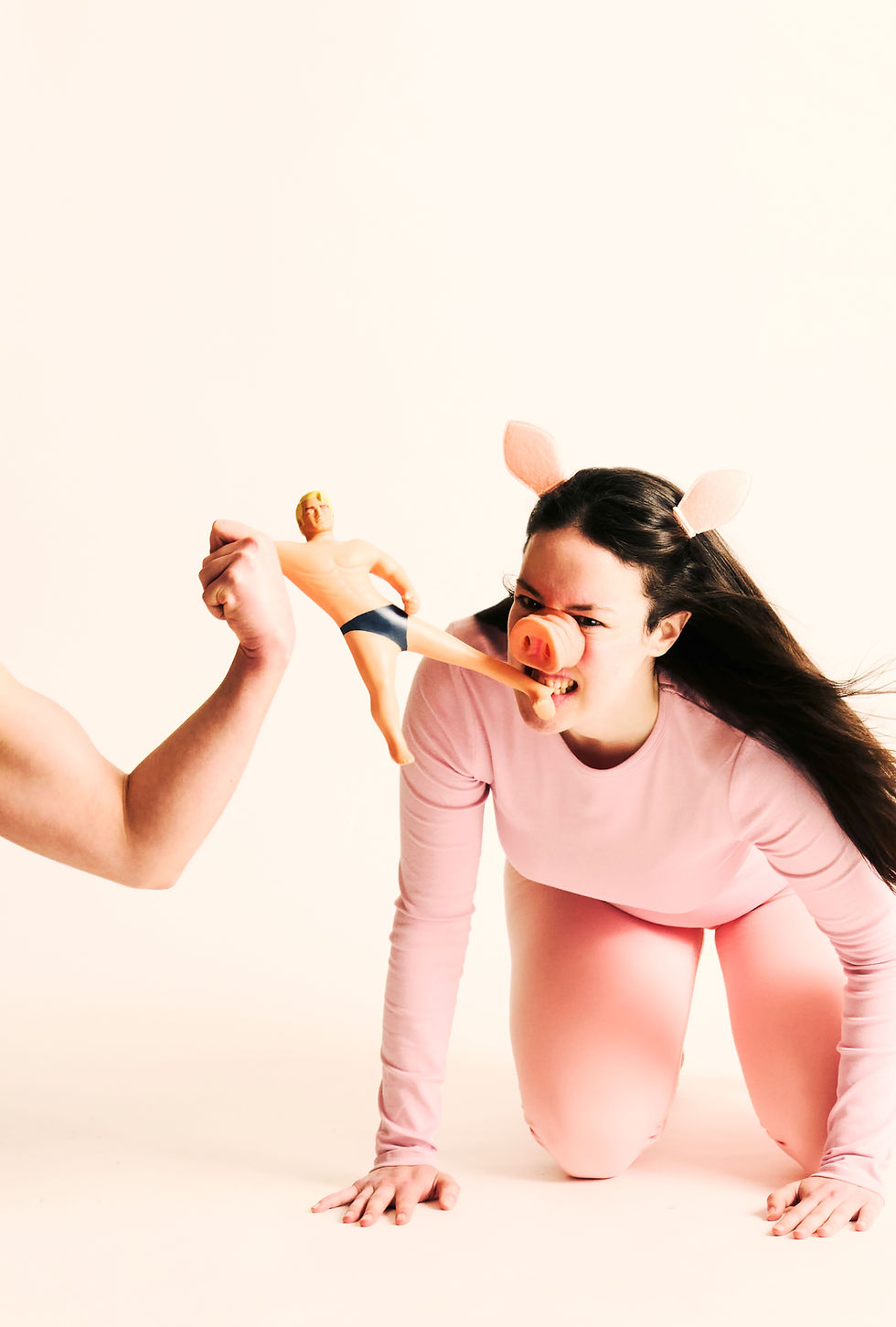
Critically acclaimed Edinburgh writer and actor Caitlin McEwan returns to the Edinburgh Festival Fringe with Two Little Pigs, a darkly comic and absurdist play exploring masculinity, loneliness and the influence of online spaces on modern male identity. After his girlfriend leaves him following his descent into alpha-male internet culture, Mark adopts a pig for companionship, only to discover she is a feminist determined to dismantle his worldview. Funny and timely, the production examines the collision between online ideology and emotional reality. We caught up with Caitlin McEwan to find out more about the show.
The story is told through a sharply comic female perspective. How did that shape the way you approached a story centred on a male character?
I think it gave me a level of objectivity that other recent depictions of masculinity on stage and on screen, written by men, don’t have. At times, especially when I was researching it, it felt like an exercise in empathy; I obviously don’t have a solution or antidote to the ideology that’s being promoted by people like Andrew Tate, but I think the worst thing you could possibly do is brand any man who expresses any degree of misogyny as toxic, evil and beyond help. You see that kind of shutting down online all the time, on both sides of the debate, and it’s obviously not limited to this issue either, it’s everywhere. I do understand why people do it, because the roots of misogyny are insidious and its effects extremely harmful, but I do think there is worth in trying to understand why some men go looking for this sort of content, and why they find solace or security in it. It was important to me that Mark wasn’t a monster, and although he does some awful things in the course of the play, I wanted the audience to root for or at least understand him.
In writing the play, I actually found it quite easy to relate to him, because the things that affect him - poor self-esteem, anxiety, feeling like he’s not in control of his life - are actually universal. And as far as a comic perspective goes, that felt absolutely essential. I’m a big believer that if people are entertained, they will listen harder, so hopefully if people come and see the play it will encourage a bit of debate, whilst also being an enjoyable way to spend an hour.
By the end, the play questions whether compassion is enough to overcome deeply held beliefs. Was leaving the audience with that uncertainty always part of the plan?
Actually, it wasn’t - without spoiling the ending of the play (as I think there are a few ways of interpreting it) I had originally written something that was more hopeful. My producer, Patrick Bone, sat me down and said ‘what if you tried something that felt a bit bleaker?’. I was reticent to it, because I thought maybe it would feel too gloomy, but I think where I’ve landed - again, without spoiling the ending! - is on how hard it is to change your behaviour and belief system. I think that’s relatable to everyone - we’re all obsessed with optimisation, starting new habits and hobbies or giving harmful ones up. My social media feed is full of people trying to change their lives in 60 days, or make more friends, or feel more positive - the videos make it look so easy, because lots of those people are influencers with a vested interest in making something hard seem achievable, but it’s actually really difficult to change your ways, and it’s often by degrees, rather than one drastic change. To see how much Mark manages to change, you’ll have to come and see the play!
Mark is searching for a clear idea of what it means to be a man. What interested you about writing a character who is so determined to find certainty?
That’s really interesting, because I think for Mark, that certainty is surface level; underneath, he’s an absolute mess of anxieties, and he has no idea how to behave. He tries to take control of things precisely because it’s much easier that way, and you don’t have to examine the intricacies of what you’re thinking or feeling, you just know that you have the power. I think that desire for a sense of control over your life is really seductive to lots of people - the alternative is randomness, which can feel completely destabilising. Mark doesn’t have anyone to talk about his anxieties with, and he’s being encouraged by the stuff he sees online not to talk about it, and to shy away from showing weakness. But he’s clearly lacking something, which is why he decides to get a pet. That Pig turns up, and is able to pick holes in his worldview, and show him the value of vulnerability, is a bit of a happy accident.
The play is a two-hander. What appealed to you about keeping the focus so tightly on these two characters and their evolving relationship?
A boring but important reason is logistical; we’re in a gorgeous but tiny space in the Pleasance Courtyard, so having a rolling cast of characters just wouldn’t be feasible. We’d be tripping over each other! But also, the kind of content that Mark is consuming at the beginning of the play thrives in secrecy, on our phones. Mark’s views become so extreme precisely because there is no-one to challenge him until Pig arrives. I knew their dynamic would be pretty charged, because their views are so polarised, and it just worked better to have nobody else getting in the way. It also means that as the play goes on, they become more codependent, with mixed results. Finally, I think it adds to the surrealist tone of the play - it’s a man and his talking pig alone in a flat for 60 minutes, and I think having them isolated from the rest of the world means that their reality at times becomes a little warped and strange, in a way that hopefully makes the audience question what’s real and what’s not - for example, is this pig really talking, or is it a figment of Mark’s imagination?
The title, Two Little Pigs, plays on a familiar fairy tale image, but in an unexpected way. When did you settle on that title, and what does it capture about the play?
The title came to me fairly early. I don’t know if there’s necessarily a correlation between the fairy tale and the play, but I did want to choose a title that felt familiar, and might lull an audience into a false sense of security. Fairytales feel cosy and comforting even though their content can be dark and scary, and similarly Mark is taking comfort from a set of beliefs that would send a chill up many people’s spines. But also, I wanted to draw a parallel between Mark and Pig, because I think the play is about the thin line between humans and animals. I’m sure there are many people who would see Mark’s behaviour and brand him a chauvinist pig, but also, Pig is anthropomorphic - she walks, talks, and is fascinated by feminist literature. They both have moments where they are more human than pig, and vice versa.
This is your return to the Edinburgh Fringe after the success of Bible John. Did having that experience behind you change the way you approached writing and staging a new show?
I think every play I write is shaped by the ones that came before. I’m always thinking about how I construct the stories I write and so every play has a bit of learning in it, in an amazing way. I don’t think the DNA of this show has a lot in common with Bible John - I suppose they’re both about big topics and the spectre of misogyny (Bible John was about the ethics of true crime and its largely female audience of consumers) - but in terms of construction they’re very different. Bible John was lucky enough to be the recipient of The Pleasance’s Charlie Hartill Theatre Reserve, which funded the run, but when I applied it was still very much a work-in-progress, and I never thought it would be chosen, so I had to write it quite quickly and when we were performing the show I was quite frustrated by the limitations of my writing. This time around, I knew from fairly early on in the writing process that Two Little Pigs would work in a Fringe context, because it takes place in one room and is a two-hander. I made a very conscious choice not to rush the writing of it, and fully develop the ideas and characters. I’m also glad, having performed at the Fringe before, to know how exhausting it can be, so I feel prepared to manage my energy whilst also taking advantage of performing at the Pleasance in a programme full of amazing shows and artists.
Two Little Pigs will be performed at 7:45pm at Pleasance Courtyard from 5th – 30th August.
Booking link: https://www.pleasance.co.uk/event/two-little-pigs


